Pages

6.11.11

NaBloPoMo Prompt: When you are writing, do you prefer to use a pen or a computer?

I use both. I guess either a pen or a computer extends a helping hand to a writer. However, each one has its own bull's eye and misses too. For instance, a pen is much more readily available than a computer. It costs nothing to use, spending only the writer's own energy. On the other hand, a computer is a more advanced companion that can serve as your editor too. However, if I will have to choose just one, I'd go for the techie assistant. Yes, the humble pen is a lot mightier in many ways, but can it alert you of a wrong spelling? Let you browse resources? Make you delete without wasting ink? Help you submit a flawless work? I bet not.


Besides, we should all save paper!


How about you, what's your pick?


David Oscarson - Pierrot Pierrette


or


Computer Keyboard


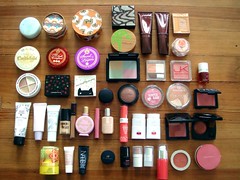
Yes Girl, Make-ups Expire

“Unopened, well-formulated cosmetics can remain stable for a couple of years at room temperature, but the clock starts once you bring a product home and open it. When air hits the formula, certain ingredients start to oxidize and degrade."
-Ni’Kita Wilson, cosmetic chemist, Cosmetech Laboratories, Fairfield, NJ
Even if THAT make-up came with a hefty price tag, you can do nothing but toss it out once it hits the D-line and starts to look like - well, not the way you bought it. Yes, make-ups have expiration dates and you have to be on guard whether what you're using is way past its shelf life.

Lipstick and Lipgloss

Rows of lipstick
Image via Wikipedia

Shelf Life: 1-2 years

Lip talk: Lipsticks contain water, an element that promotes bacterial growth. After two years, you need to throw it out of your purse.

Lipliner


Lipstick used to make a symbolic kiss.
Image via Wikipedia

Shelf Life: 2 years or more

Shape your lips: Lipliners last a little longer because a new, clean surface comes out whenever you sharpen it. Just do take note that you have to sanitize your cosmetic sharpener too before using! 

Face Make-up


Face make


Shelf Life: 6 months (liquid), 2 years (powder)

Retouch: A liquid foundation is more likely to catch germs because of the way it is used. Frequent dipping of your brush or fingers to the foundation transfers bacteria. Aside from cleanliness issues, foundations also become uneven if applied when they're already expired. Powder foundations last longer because they have no water content. However, if the powder contains aloe or jojoba, it becomes hard and crumbles after a long time. Another piece of advice too - use a clean sponge for your powder or cake foundation. 

Eyeliner


2 woodless graphite pencils in plastic sheaths...

 Shelf Life: 3 months (liquid), 6 months (pencil)

Beautiful eyes: Liquid eyeliners are stored in bottles that are dark and wet - the perfect environment for bacteria to thrive and multiply. On the other hand, pencil eyeliners (like pencil lipliners) have more shelf life than liquid ones because a new surface comes out whenever you sharpen it.

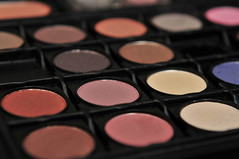
Eye Shadow

Eye shadow
Image by kurafire via Flickr

Shelf Life: 6 months (cream), 2 years (powder)

Add some color: A powder eye-shadow lasts longer because it contains no water as compared to the cream one. However, if you did wet a powder shadow, you need to toss it out post six months too. Plus, if its shade fades when applied, it's game over. 

Woman applying make-up. Canon 5D Mark II Sigma...
Image via Wikipedia

Mascara

Shelf Life: 3 months

Lengthen your lashes: Just like liquid eyeliners, mascara tubes serve as sanctuaries for bacteria. Cristina Bartolucci (make-up artist) says that to prevent drying-out your mascara fast, don't pump its wand. Instead, draw it out in a twisting motion.

Remind yourself:

With all the work to do and busy life to live, who would care much about remembering a make-up's demise? Keeping track of your make-up's shelf life can be difficult - yet you can always be resourceful. Keep a journal or put a small expiration date label on your cosmetic using a masking tape. If you want, you can be extra creative by printing girly stickers (with the expiration dates) - you're not just doing yourself a favor but you're also prettifying your beauty arsenal! 

If you're the techie kind of gal, you can use the help of technology by using a Cosmetic Calculator. It's a program that reveals the expiration date of a cosmetic using its batch code or lot number.


It's always heart-breaking to throw something you know is precious like your favorite make up. But life's like that. No matter how important a thing is to us, when it's time to let it go - let it go!


Good thing though, when it comes to cosmetics you can always buy a new one or find something better than the one you threw away. Save yourself from all infections, allergies, and skin diseases - know when to throw your make-up, girl!

Don't forget: You can be a Scrooge for items that expire easily, but do invest big in make-ups that last longer. Moreover, do not settle for "extremely cheap" make-ups just for the reason that you're gonna toss it out anyway. Remember, you put make-ups on your FACE - a beautiful one deserves nothing but the best.


Topic source: Good Housekeeping


NaBloPoMo Fever!

Just yesterday, I signed myself into BlogHer's NaBloPoMo (National Blog Posting Month) challenge. It's an event that encourages writers to make a post each day on their blog for one whole month! When I made my yes to this, a giant thought bubble automatically popped out: What the hell was I thinkin'? Posting everyday for one whole month? How the hell can I possibly do that?

Okay, 'nuff with the ranting. It's a voluntary choice actually. Besides, I was thinking that this challenge shall serve as my motivation to really keep my blog alive and poppin' for the whole month of November. And perhaps, if I get used to it I'd probably blog everyday until the following years!

What is NaBloPoMo?


As what I've said, this is an event sponsored by BlogHer where a particular blogger is forced challenged/encouraged to write something on his or her blog for one whole month (In this case, the whole month of November). In a way, it resembles Wordpress' Post a Day/Post a Week challenge.


Hundreds, and even thousands of bloggers join in this event. And what's even meatier about it is that the organizer (BlogHer) spruced the event up by having prizes at stake! Unfortunately, the prizes are for US residents only (sigh).

BlogHer chose the theme: Blogging for Blogging's Sake this November and I think it really suits the season well.

The Difficult Part of NaBloPoMo


As a new blogger (see my post about it), I'm still learning my way through the ins and outs of the whole "blogsphere" and I'm just in the process of testing out my wings, flapping it a little, secretly wishing that I can already fly - so I guess my biggest challenge for this event is the writing itself.

I'm afraid I'm not a consistent writer. I mean, I always do suffer from what they call the "writer's block." My brain and digits don't really synchronize well with each other unless a huge inspiration hits me - and when I say huge, I really mean something HUGE like a) when I've read a really good book and I wanted to make a review out of it, b) when good news knocked on my door, and c) whenever my sleeping creativity awakes.

Good thing though, BlogHer provides NoBloPoMo prompts each day for those writers who can't really think of something to blog about. The questions are really nice and it'll provoke your mind to write.

I'm really having my fingers crossed right now that I can live up to this situation I've gotten myself into. Nevertheless, I guess joining NaBloPoMo is actually a good idea, especially since I'm an aspiring writer.

The Plus Points of Joining NaBloPoMo


There are two good things NaBloPoMo grants to bloggers. One, each blogger will be able to practice his or her writing skills. Second, each blogger will be able to increase his or her site stats because of daily posting.

In many ways, I think NaBloPoMo is a great event for bloggers to showcase themselves, gain friends, read other blogs, improve, and just have fun writing!

If you're interested in joining NaBloPoMo for this December (Sorry, November signing ended up yesterday), you may visit BlogHer and subscribe to their newsletter for updates.

[caption id="attachment_223" align="aligncenter" width="300" caption="Click the image if you wanna know more about NaBloPoMo"]NaBloPoMo[/caption]

In addition, you can check out the blog entries of NaBloPoMo participants. I'm smiling right now because I just did my first post! One down. How many posts left?

By the way, I'm blogger number 2187 in NaBloPoMo!

2.11.11

How to Make a Lacy Black Top

Transform a plain, simple black spaghetti


into a lacy classic black top!


Today, I'm feeling a little crafty and so I've decided to re-invent my plain, black spaghetti into something elegant and classy - a lacy top! So, are you ready to get creative today? You can do the following invention in just thirty minutes to an hour (even less, if you're fast)!

Things you'll need:


Plain black spaghetti top
scissors
white thread
lace (about 1.5 to 2 inches wide)
basic sewing skills


Let's get started!


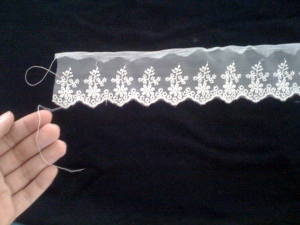
  • Make a small fold on the top end of the lace. You may iron it out if you want.


[caption id="attachment_186" align="aligncenter" width="225" caption="small fold on top"][/caption]

  • Sew a loose running stitch over the folded area of the lace. Make a small fold on one end of the lace before you start stitching.

    [caption id="attachment_174" align="aligncenter" width="225" caption="This is your anchor"][/caption]


[caption id="attachment_200" align="aligncenter" width="300" caption="Perform a loose (wide-spaced) running stitch"][/caption]

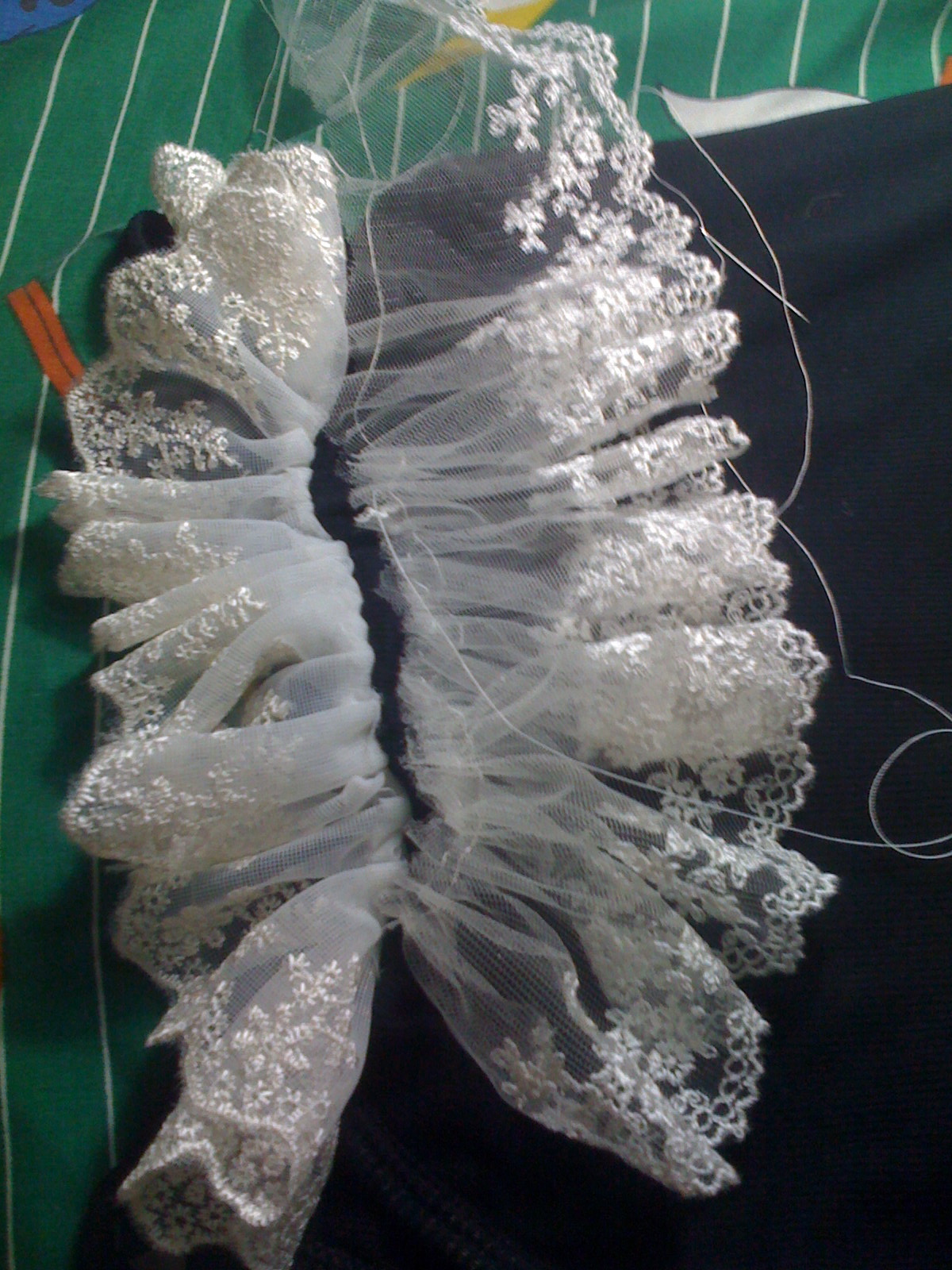
  • After making the running stitch, it's time to create "the waves" - you can simply push the lace to one end (the one where your anchor is).


[caption id="attachment_203" align="aligncenter" width="300" caption="Push the lace to one side and you create the waves"][/caption]

  • Once you already have your "wavy lace," it's time to transfer it to the top. You should pass the needle and thread from the back of the top to the front and pass it through the "wave" of the lace. See the diagram below.


[caption id="attachment_206" align="aligncenter" width="430" caption="Take note where the needle should insert"][/caption]

[caption id="attachment_187" align="aligncenter" width="225" caption="This is how your work should look like"][/caption]

  • You should make sure that you've sewn securely the lace to the top. If you're going to take a peek at the back side of the top, it will look like this:


You can hide the white patches (thread) by using a black marker.


Finished product:


Variations:


You may also make multiple lace layers! Just follow the same drill.


[caption id="attachment_189" align="aligncenter" width="225" caption="Adding a second layer"][/caption]

[caption id="attachment_190" align="aligncenter" width="225" caption="Two-tiered top"][/caption]

[caption id="attachment_192" align="aligncenter" width="225" caption="If you want, you can go up to three layers! Just don't overdo the ruffles with a fourth one. ;)"][/caption]

Price:


Making this lacy top is quite simple and inexpensive too:


Black plain top - around 50 Php (Greenhills or outfit stores)


Lace - 29 Php per meter (department store)


thread, needle, scissors - just borrow your mother's


basic sewing skills - costs only your time of learning it


Strut your lacy top!


Laces and ruffles always create an impression of girly-ness, elegance, and class in any piece of wardrobe. If you feel like you wanna turn something drab to fab, just get your creative juices flowing!

[caption id="attachment_207" align="aligncenter" width="181" caption="Lady-like!"][/caption]

*Yehay! It's my first tutorial! Sorry for the blurry snaps, I just used an iphone.

Depression and Alcohol - How are They Related?


[caption id="" align="alignleft" width="240" caption="Image by Lynda Giddens via Flickr"]Alcohol![/caption]


Depression and alcohola mood disorder and an addictive substance – these two things are always linked together. There are many accounts and statements, which point to the idea that alcohol leads to depression and depression, on the other hand, also intensifies alcoholism. However, the big question is, how did these two things really get related? The following statements briefly discuss the connections between the two.


Depression and Alcohol – a Dangerous Combination


One of the principal reasons why depression and alcohol are closely associated with each other is that the two complement one another in creating one vicious scenario – suicide.

Alcohol causes a person to lose his or her inhibitions. A person under alcoholic influence becomes aggressive and is capable of doing violent acts. If, by any chance, that person has depression and is contemplating of committing suicide, alcohol might just be the “push” that he or she needs before the plan is transformed into an action.

Suicide is a fatal decision, and depressed and alcoholic individuals who are at their wit’s end do not recognize that what they are about to do is against moral and societal virtues. According to the American Foundation for Suicide Prevention, an organization committed to the prevention of suicide, more than 60% of individuals who died by suicide have suffered from major depression. In addition, 30% of all completed suicides have alcohol as one of the factors that influenced the successful performance of the brutal act. Evidently, alcoholism and depression increases the risk for suicide of an individual suffering from depression.

Depression and Alcohol Lead to Bigger Problems


Depression and Alcohol produce an additive effect; both greatly increase each other’s negative outcome. For instance, a depressed person who takes alcohol becomes more depressed because alcohol is a depressant if taken in large amounts. The same is true with alcoholics; the more they depend on alcohol, the more chances that they’ll end up being depressed.

Considering this additive effect, depression and alcohol then can also lead to several other serious problems such as physical health problems, decrease in work performance, social isolation, relationship issues, family problems, anxiety, emotional instabilities, and sleep disturbances.

Depression and Alcohol Treatment: A Call to Action


The treatment for Depression and Alcohol problems is a combination of different treatment modalities, which all require some degree of cooperation and support to become successful. Depression symptoms can be addressed properly by using therapeutic drugs (primarily antidepressants) and psychological assistance such as counseling, behavioral, and cognitive therapies.

On the other hand, alcoholism or alcohol dependence can be managed through physical detoxification and by using invaluable human resources such as asking the help of a counselor, a good friend, or a trusted family member. Joining Alcoholics Anonymous (AA) is also a very promising option.

Depressed alcoholics should bear in mind that treating their abnormal mood state and excessive compulsion to drink alcohol would need a great deal of sacrifice. Nevertheless, the first and foremost step in achieving freedom from Depression and Alcohol is actually acknowledging that a problem in relation to this actually exists.

The moment that the afflicted person acknowledges his or her vulnerability - it makes the treatment process of eradicating depression and alcohol a lot easier.

Related articles

Why Depression?


[caption id="" align="alignright" width="180" caption="Image via Wikipedia"]Depression[/caption]


As a nurse, I feel like I have a strong commitment to inform the public about this thing called depression. Although my blog is mostly about girly stuffs and the like, I figured it wouldn't hurt if I butt-in a couple or so articles about "serious health matter"s from time to time.

Today, I feel like writing something about depression.


Depression is not just something that you can shrug off. Whether you are aware of it or not, this condition is actually prevalent in your surroundings. You never know, perhaps your family member, friend, or neighbor is already experiencing this (and if they really are, then you must be on your guard since depression can lead to suicide).

So, what's depression?

Being down and feeling blue at times (especially when something bad just happened) is just normal throughout the life of an individual. Normally, you will just get past that feeling after a week or so. However, if you have depression, your feelings of loneliness and abandonment can extend for up to two weeks or more.

Psychologists diagnose depression according to the symptoms the patient displays which are already manifesting for more than two weeks. These symptoms may be either of the following:

  • disturbed sleep pattern (either you sleep more or sleep less)

  • disturbed eating (either you eat more or eat less)

  • feeling sad

  • anhedonia (you don't find your usual hobbies or activities pleasurable anymore)

  • Anergia (loss of energy)

  • Physical symptoms like hyperacidity

  • loss of libido


There are a lot more symptoms related to depression, but these things I've mentioned are the most common ones.

There are several factors believed to be the causes of depression - it can be severe life changes or experiences, genetics, biological factors (the play of hormones in your body) and sometimes even your lifestyle.

Help someone with depression


If you know someone with this kind of dilemma, don't hesitate to offer your presence. You don't have to necessarily give solution to that person's problems if he or she has one, neither make fun of yourself just to make him or her smile. All you need to do is to be his or her friend during that difficult time. And also, be alert for signs of suicide. If you can, then you may refer your friend to a psychologist - this is perhaps the best way you can be of help.

About Postpartum Depression


[caption id="" align="alignright" width="300" caption="Image via Wikipedia"]Breastfeeding offers benefits for both mother ...[/caption]


Postpartum Depression (PPD, Postpartum psychosis) is a type of depressive disorder that affects a number of mothers after giving birth. The intensity of this depression ranges from moderate to severe. It can occur very soon after the delivery, most likely within the first three months, or it can develop after some time, say, after a year.

What Causes Postpartum Depression?

Normally, pregnant women do experience mood changes during pregnancy, a situation closely related to hormonal level changes in response to the needs of the growing fetus. Shortly after delivery, approximately one of two weeks, women may experience certain feelings of irritation, anxiety, restlessness, tearfulness, and the feeling of being abandoned. This kind of emotional shift, in itself, is also considered normal and is even termed as postpartum blues or baby blues.

This normal “baby blues” may deteriorate into postpartum depression if these down and sad feelings do not go away or when the mother starts to exhibit early manifestations of depression.

The exact cause of postpartum depression then may not be solely attributed to hormonal changes or the sudden addition of a new role (parenthood), the cause of postpartum depression may be attributed to several factors that present the risks for this type of condition to develop.

The following can increase the chances of developing postpartum depression:

- Maternal age of below 20

- Alcohol and other illegal substances abuse

- Presence of certain mental disorders before the actual pregnancy (bipolar disorder, anxiety disorder)

- Family history of depression

- Single motherhood due to divorce or separation

- Financial problems

- Lack of support system

- Stressful events prior of during the delivery (death of a loved one, illness in the family, premature delivery, birth defects and death of the baby)

What are the Symptoms of Postpartum Depression?

The symptoms of Postpartum Depression are the same as with the general symptoms exhibited by depression, but with additional manifestations. The following are the symptoms of Postpartum Depression:

The symptoms of Postpartum Depression are the same as with the general symptoms exhibited by depression, but with additional manifestations. The following are the symptoms of Postpartum Depression:

- Feelings of worthlessness, helplessness or hopelessness

- Change in appetite, either eating more or eating less than the usual

- Isolation

- Irritability or agitation

- Anhedonia (lack of interest or pleasure in doing most or all kinds of activities)

- Anergia (loss of energy)

- Loss of concentration

- Poor work performance

- Feeling of being abandoned by family members and significant other

- Negative feelings directed to the baby (thoughts of harming the baby)

- Anxiety

- Sleeping problems

- Thinking of suicide

- Neglect of the baby

- Being afraid to be alone with the baby

- Have little interest in the baby

Postpartum Depression is diagnosed using a series of tests and observation. The doctor may use a Postnatal Depression Scale questionnaire to signs and potential risks of depression in the patient. Results of medical tests such as a blood test may rule out depression and give the impression that the unfavorable feelings were due to an underlying disease process and not entirely a symptom of depression.

How is Postpartum Depression treated?

The treatment of Postpartum Depression involves the use of pharmacotherapy (medications) or psychotherapy (counseling, behavioral and cognitive therapies). In other cases, the two methods are used together.

A woman diagnosed of Postpartum depression is placed under security observation for at least six months. Aside from the standard treatment modalities, managing depression also needs the support of family members and significant others.

If Postpartum Depression is screened early and the proper management is promptly applied, its symptoms are highly manageable and treatable. On the other hand, although the prognosis of postpartum depression is good, the best option is still prevention of this condition through establishing a strong support system.